Bridging Experiments and Modelling
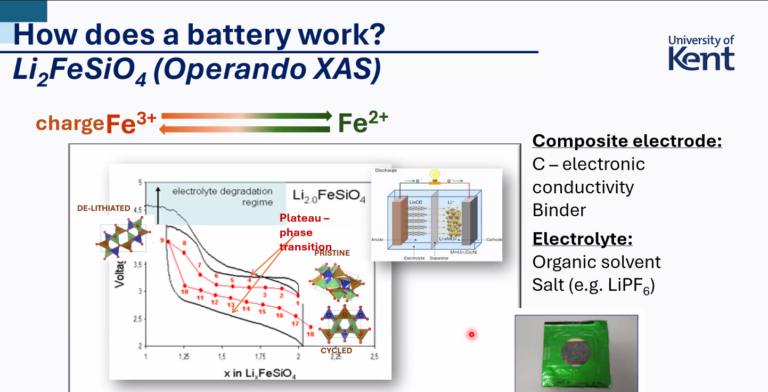
Modern battery research relies on a combination of complementary techniques. Experimental methods provide detailed observations of materials and interfaces. However, interpreting these observations is often not straightforward. Multiple explanations can appear equally plausible. Identifying the true mechanism requires additional tools. Computational modelling helps close this gap. It supports experimental interpretation and provides deeper insight into underlying processes.
What Modelling Makes Possible
The session featured Maria Alfredsson (University of Kent).
The presentation demonstrated how modelling approaches such as Density Functional Theory (DFT) and molecular dynamics simulations can:
- calculate structural and electronic properties
- interpret complex experimental datasets
- predict ion transport and interfacial reactions
- identify degradation pathways in battery materials
These approaches make it possible to access information that is difficult — or impossible — to obtain experimentally.
From Data to Understanding
The webinar showed how modelling and experiments work together. Experiments provide observations. Modelling provides explanation and prediction.
This combined approach helps researchers:
- resolve ambiguities in data
- test hypotheses
- guide future experiments
It enables a more complete understanding of how battery materials behave during operation.
Strengthening Interface Science
Understanding interfaces remains one of the key challenges in battery research. Processes such as ion transport, charge transfer, and degradation occur at the microscopic level. By combining operando techniques with modelling, researchers can better link these processes to real battery performance. This is essential for developing safer, longer-lasting, and more efficient energy storage technologies.
Strengthening the European Battery Research Community
The Battery2030+ webinar series continues to serve as a platform for collaboration and knowledge sharing across Europe’s battery research ecosystem. Through joint efforts by OPINCHARGE, OPERA and ULTRABAT, the initiative connects researchers working on advanced characterisation methods and supports innovation in battery interface science.
By advancing understanding of ion–lattice interactions and solid-state interfaces, the series contributes to the development of next-generation energy storage technologies for a sustainable future.