Why Ultrafast Processes Matter
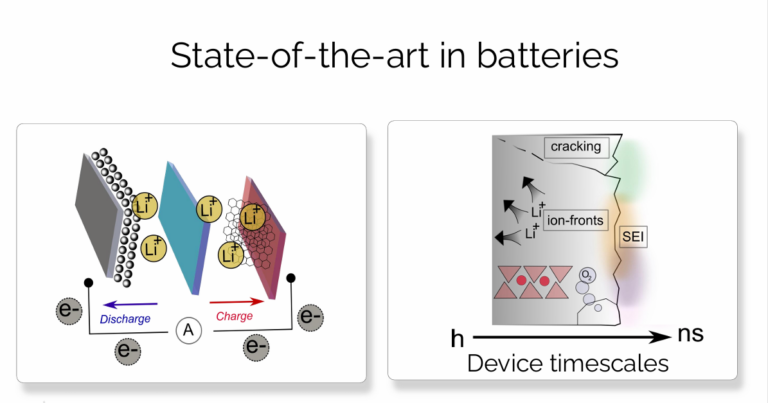
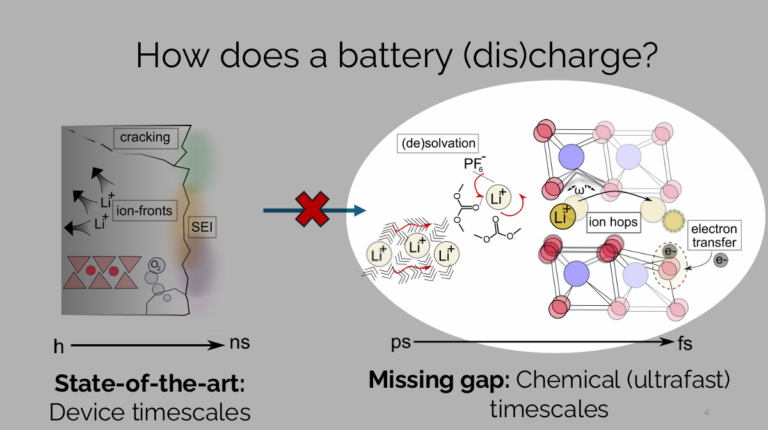
Many key processes in batteries happen on extremely short timescales — far beyond what conventional techniques can capture.
While most measurements focus on device-level behaviour, critical steps such as ion transport, electron transfer, and (de)solvation occur on ultrafast timescales and strongly influence performance.
These processes are directly linked to charging rates, capacity loss, and interface stability.
Closing the Gap Between Scales
A central challenge in battery research is the gap between microscopic processes and macroscopic performance.
Understanding how atomic-scale dynamics translate into real battery behaviour remains difficult.
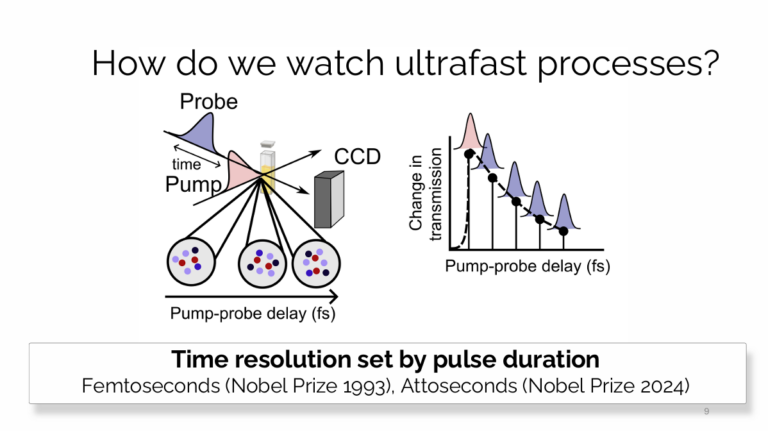
Non-linear spectroscopy offers a way to bridge this gap by probing time-dependent correlations and ultrafast dynamics inside materials.
What Can Non-linear Spectroscopy Reveal?
The webinar featured Raj Pandya (University of Warwick), who presented how non-linear spectroscopic techniques can uncover ion motion and lattice dynamics.
These methods allow researchers to:
• probe ion motion at THz frequencies
• track how ions interact with the surrounding lattice
• capture correlations and fluctuations beyond conventional measurements
This provides a much deeper understanding of how ions move through materials and how this affects conductivity and performance.
From Observation to Control
The presentation also showed that spectroscopy is not only a tool for observation.
THz-based approaches can actively excite ionic motion and probe how materials respond to external fields.
This opens new possibilities for studying — and potentially controlling — ion transport in battery materials.
Open Questions for Future Research
Despite recent advances, several key questions remain:
• How strongly is ion motion coupled to lattice dynamics?
• Can we observe transition states during ion transport?
• Is it possible to actively control ion conduction at the microscopic level?
Addressing these questions will be essential for the development of next-generation batteries.
Strengthening the European Battery Research Community
The Battery2030+ webinar series continues to serve as a platform for collaboration and knowledge sharing across Europe’s battery research ecosystem. Through joint efforts by OPINCHARGE, OPERA and ULTRABAT, the initiative connects researchers working on advanced characterisation methods and supports innovation in battery interface science.
By advancing understanding of ion–lattice interactions and solid-state interfaces, the series contributes to the development of next-generation energy storage technologies for a sustainable future.