Why silicon anodes matter
Silicon is considered one of the most promising materials for next-generation lithium-ion batteries, as it can store significantly more lithium than conventional graphite anodes. However, this advantage comes with a major challenge: during charging and discharging, silicon undergoes extreme volume changes, which can lead to mechanical degradation, particle fracture and reduced battery lifetime.
Modelling the silicon–SEI system
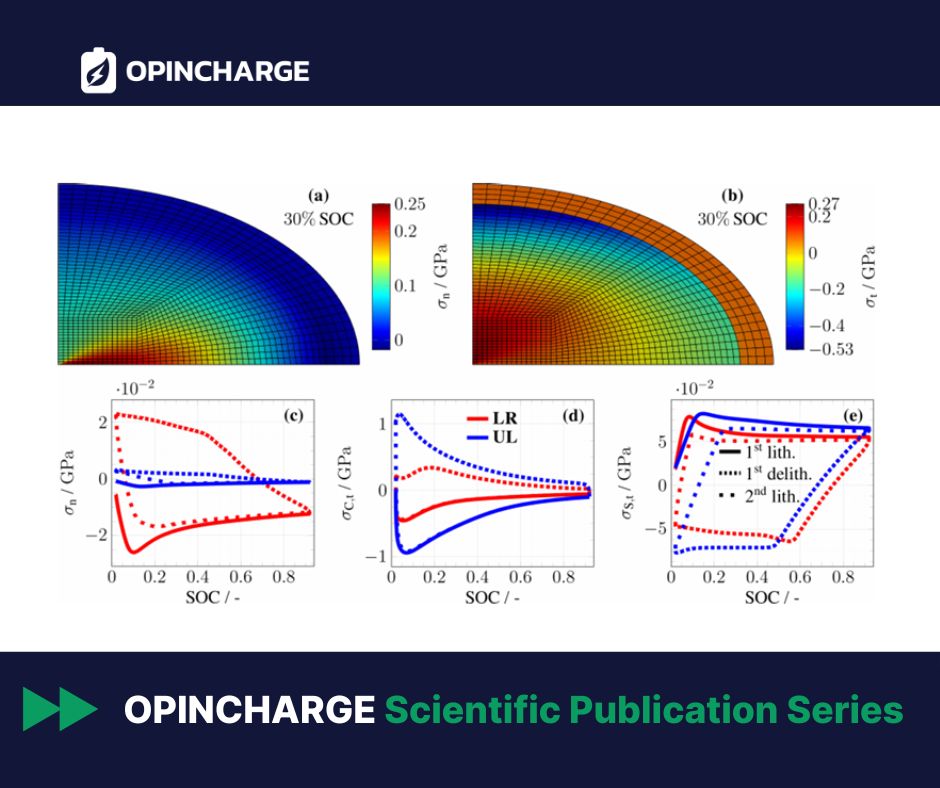
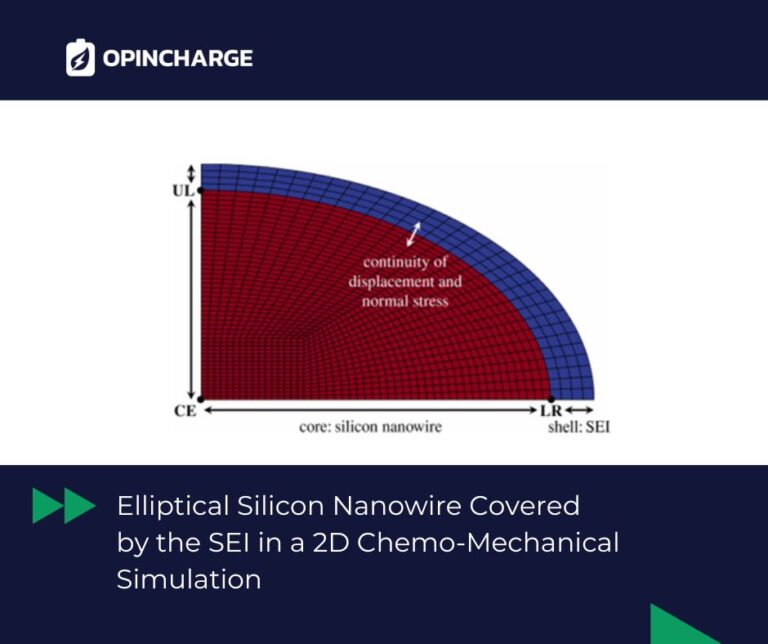
The study investigates an elliptical silicon nanowire surrounded by the solid-electrolyte interphase (SEI), a thin layer that forms on the surface of the anode and plays a key role in battery stability. Using a 2D chemo-mechanical simulation, the researchers analyse how lithium transport, mechanical stress and material deformation interact during cycling, comparing a soft SEI layer, which adapts to volume changes, with a stiff SEI layer, which resists deformation.
Key findings
The results show that geometry plays a decisive role in silicon anode behaviour. Elliptical nanowires experience non-uniform stress distribution, with certain regions exposed to significantly higher stress levels, increasing the risk of mechanical failure. The study also reveals unexpected concentration anomalies, where lithium distribution deviates from typical diffusion patterns due to the coupling of mechanical stress and electrochemical processes.
Importantly, a stiff SEI increases internal stress and can accelerate degradation, while a softer SEI better accommodates deformation and supports improved stability.
Why this matters
These findings highlight the importance of combining mechanical and electrochemical modelling when studying battery materials. Ignoring mechanics can lead to incomplete conclusions about performance and degradation. The research also shows that particle shape and material properties must be designed together, which is particularly relevant for silicon-based anodes.
Towards more durable batteries
By uncovering how geometry, stress and lithium transport interact, this work contributes to the development of more durable and efficient lithium-ion batteries, helping bridge the gap between high theoretical capacity and real-world reliability.