Why silicon anodes are promising
Silicon is considered one of the most promising materials for future lithium-ion battery anodes.
It can store significantly more lithium than traditional graphite anodes, which could substantially increase the energy density of batteries used in electric vehicles and energy storage systems.
However, silicon also expands dramatically during charging. These large volume changes generate internal stresses that can damage electrode materials and affect battery performance over time.
Understanding how silicon behaves during battery cycling is therefore essential for developing durable high-capacity batteries.
The challenge: voltage hysteresis and relaxation
Silicon anodes exhibit a phenomenon known as voltage hysteresis.
This means that the voltage during charging differs from the voltage during discharging.
Such behaviour reduces energy efficiency and complicates battery management and state-of-charge estimation.
Experiments have also shown that the voltage of silicon electrodes can continue to relax for many hours or even days after cycling, which has remained difficult to explain.
A chemo-mechanical core–shell model
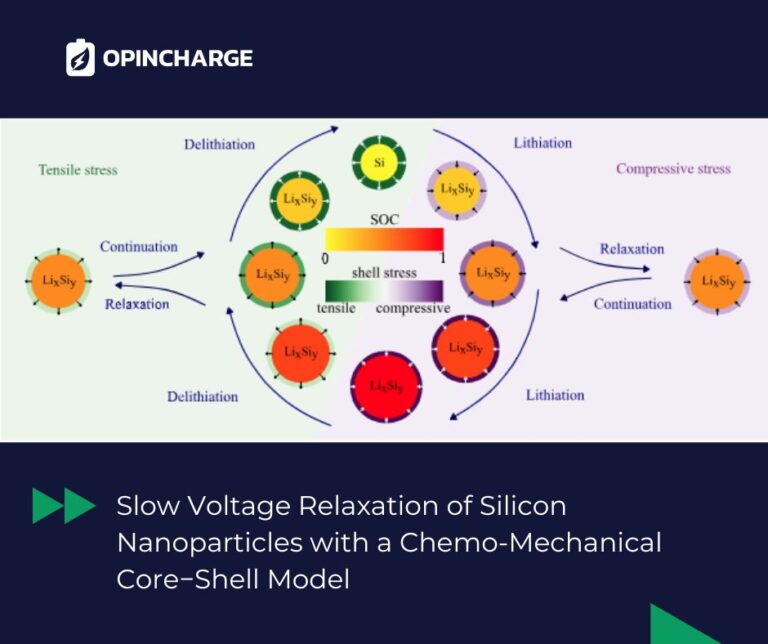
To better understand this behaviour, the researchers developed a chemo-mechanical core–shell model.
In this model, the silicon nanoparticle forms the core, where lithium enters and leaves during battery operation.
Around the particle, a solid-electrolyte interphase (SEI) forms a shell that does not participate in electrochemical reactions but plays an important mechanical role.
The model shows how mechanical stresses in this shell influence the electrical behaviour of the silicon particle.
Key findings
The research demonstrates that the slow voltage relaxation observed in experiments follows a logarithmic behaviour over long time scales.
This behaviour can be explained by viscous mechanical relaxation in the shell surrounding the silicon nanoparticle.
The model successfully reproduces several experimental observations, including voltage hysteresis during cycling and the gradual voltage relaxation during rest periods.
Supporting the design of better batteries
Understanding the interaction between mechanical stresses and electrochemical processes is essential for designing improved battery materials.
The insights from this study help researchers better understand how silicon electrodes behave during battery operation.
Such knowledge supports the development of more stable silicon-based anodes and contributes to the design of high-energy lithium-ion batteries for future energy systems.